

Why Does the Next Decade Belong to Open Source?


Open Source just turned 50. From your pocket to outer space, it’s already everywhere: powering the Android OS in your smartphone and the software that drives NASA’s rovers on Mars. It runs 90% of the world’s servers, most of the internet’s databases, and more than two-thirds of global smartphones. Yet just a decade ago, it was still often dismissed as the “free alternative” to closed source, great for developers and infrastructure, but rarely considered a path to building the next tech giant.
That perception has flipped. Today, open source is not just mainstream; it is the beating heart of the software industry. More than 65% of all software used by businesses is Open Source. It can monetize as efficiently as proprietary software, powers the entire AI revolution, and is embraced by governments and enterprises as the only credible path to digital sovereignty. In short, open source has moved from the margins to the center of global strategy, economics, and technology.
We are at an inflection point: open source is not just eating the world, it’s rewriting the rules of the software economy.
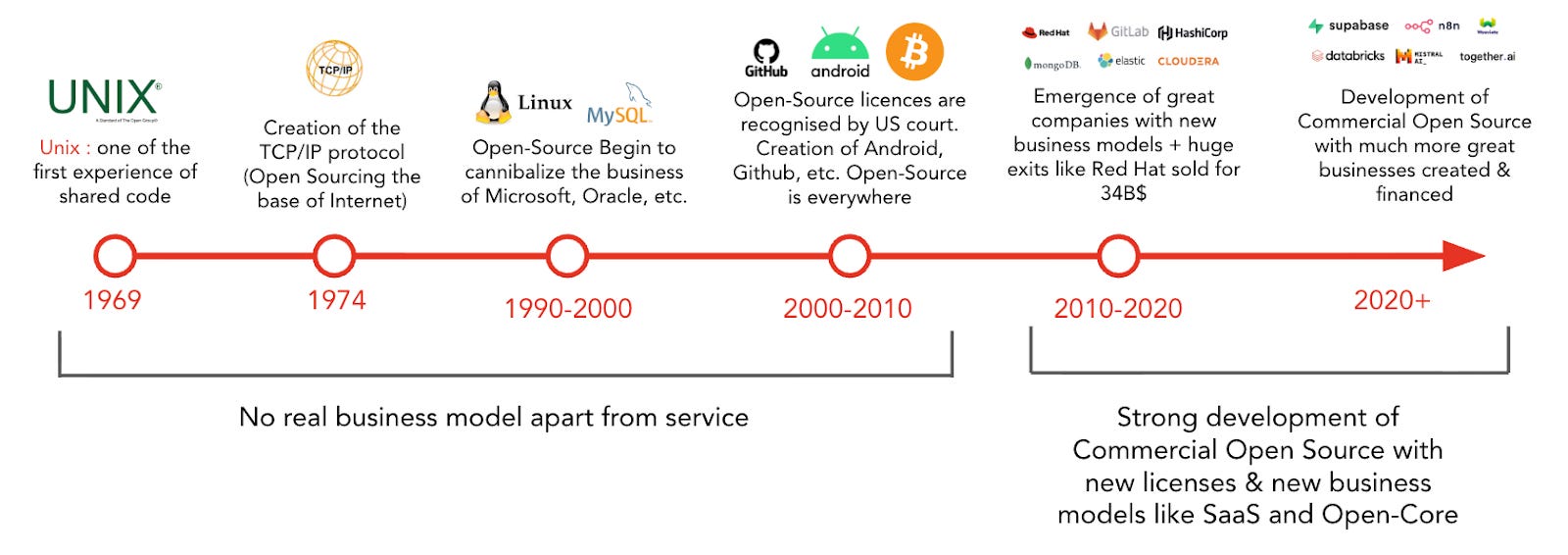
In this article, we will dive into the different trends and reasons behind the growth of Open Source, and why we believe that the next decade will see open source companies dominate the software landscape the way cloud-native SaaS did in the 2010s.
1. Open Source Monetization Has Caught Up With Closed Source
For years, skeptics said, “you can’t make money with open source.” That myth is vanishing. What changed is not just adoption, but the evolution of business models, from one-off services to recurring, SaaS-like revenues.
Early Days – Services & Support
The first generation of open source companies (think Red Hat) proved you could monetize by offering support, training, and consulting on top of free software. It was a great business (Red Hat generates more than 6B$ of revenue per year and was bought for $34B), but it’s not really scalable and doesn’t generate SaaS like margins.
The Open Core Model
The next wave (2005–2015) introduced open core: the core product is open source, while advanced enterprise features, security, and compliance tools remain proprietary. It allows to create a strong community of developers, small companies, and individual contributors around the core product, allowing to building a bottom-up Go-To-Market approach for enterprise clients. The code being Open Source, it is self-hostable, auditable, flexible, and if the underlying company shuts down, its clients can still access it. It gives enterprise customers trust even when the product is critical and supported by a small startup, and allows this startup to monetize through specific features.
Companies like Elastic (Elasticsearch, $1.2B revenue) and MongoDB ($1.7B revenue in 2024, growing >25% YoY) thrived for years with this model, balancing community adoption with enterprise monetization.
Managed Hosting & Cloud.
Then came the cloud-native era. Instead of asking customers to deploy and maintain the software themselves, companies offered fully hosted, managed versions of their Open Source project. This turned Open Source into SaaS, with all the efficiency of cloud delivery, but with lower lock-in (which is today essential to get enterprise customers).
Databricks, built on Apache Spark, perfected this model and is now valued at $100B with $4B+ ARR. Confluent, commercializing Kafka, also succeeded by offering a managed streaming platform (now a $770M+ revenue public company).
Other & hybrid models
These are not the only business models available for Open Source startups. Beyond the “classic three” (Open Core, Managed Hosting, and Services), founders have developed additional strategies:
Marketplace: building an OSS core and monetizing through paid plugins, themes, or extensions (e.g. WordPress, Grafana).
Data: software is free, but curated datasets, pre-trained models, or benchmarks are monetized (e.g. Hugging Face Datasets, proprietary model checkpoints).
In practice, most successful open-source companies combine several models. Mistral (who is not really Open Source but Open Weight) is a perfect illustration:
Services: It sells specific services and maintenance through strategic partnerships with large enterprises such as BNP Paribas, CMA CGM, and others.
Open Core: It offers unique enterprise features and optimized versions of its public AI models (the base models remain free).
Hosting: It also hosts its own models and provides online access for clients who don’t have the computing capacity to run them in-house.
This hybridization of models is what makes today’s Open Source startups so powerful: they capture the viral adoption of open source while unlocking multiple monetization streams, rivaling or even surpassing the efficiency of SaaS peers.
The result? Revenue traction equal to or better than closed-source SaaS peers (e.g. graph below).
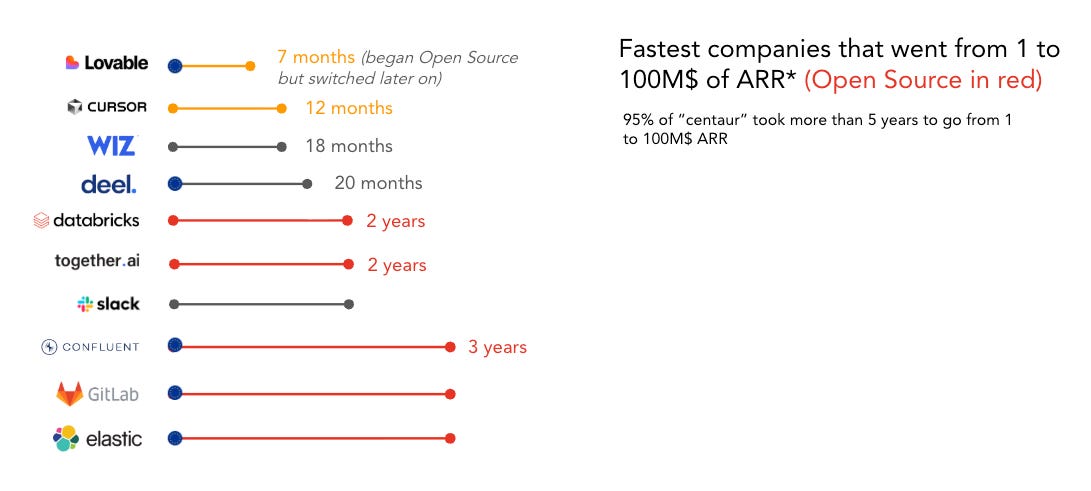
The story is clear: open source is not a handicap; it’s a valuation multiplier. Companies like Databricks, MongoDB, Elastic, Confluent, Mistral, and hundreds of others have proven that OSS can scale to millions, if not billions, in revenue while creating some of the fastest unicorns in history. It also helps create large-scale adoption and a community that can turn into strategic assets. This empowers a new wave of Open Source companies to emerge because it has become the best way to build any software infrastructure or developer tools company.
2. Open Source Is Winning the AI Race
AI has been built on Open Source collaboration since its very inception. Today, the most widely used AI frameworks, including Scikit-Learn (developed by INRIA, with over 2.2 billion downloads), TensorFlow (by Google), PyTorch (by Meta) and Keras are all Open Source, enabling researchers and developers worldwide to build on each other’s progress.
The new AI boom is a once-in-a-lifetime business opportunity. Y Combinator predicts that it will be >10x bigger than SaaS. For Goldman Sachs, it will replace 300M jobs by 2030, and IDC research projects that it will add 20T$ to the global economy by then.
And Open Source has become a core engine of this boom, to the point that it’s winning the AI race. According to the Stanford Institute for Human-Centered Artificial Intelligence, in 2023, 65.7% of newly released AI foundation models were open (it was just 44% the year before). That means the majority of cutting-edge models, from image generators to large language models, now come with open weights or code. It doesn’t mean that they are fully Open Source, and there is an important debate around that, but that’s for another article 🙂
Closed models (like OpenAI’s GPT-5) still often lead in raw performance, but the gap is closing fast. In fact, an internal Google memo admitted in 2024 “We Have No Moat... Open source models are faster, more customizable, more private, and pound-for-pound more capable”.
That prediction became reality: this year, an open model by DeepSeek outperformed OpenAI’s best reasoning model on certain benchmarks while being 20 to 40× cheaper, proof that open source is overtaking proprietary AI.
And it’s not just the models, as AI is infusing every business, application, hardware device, etc. The infrastructures that will fuel the AI revolution for the next decades are being built now, and they are being built on Open Source.
In the enterprise, over half of AI solutions are already built on open-source foundations.
Databricks is outgrowing Snowflake and becoming the leading solution to build data infrastructures in the age of AI. Firms like Together.ai or Baseten offer open-source platforms for hosting and fine-tuning models, others like LangChain provide frameworks to build AI applications, etc.
Open Source is taking the lead in most layers of the AI value chain: tools for AI observability, data synthetic generation, vector databases, deployment, and much, much more. This positions open-source companies to capture enormous value in the AI era.
3. Sovereignty Push: Open Source as a Strategic Lever
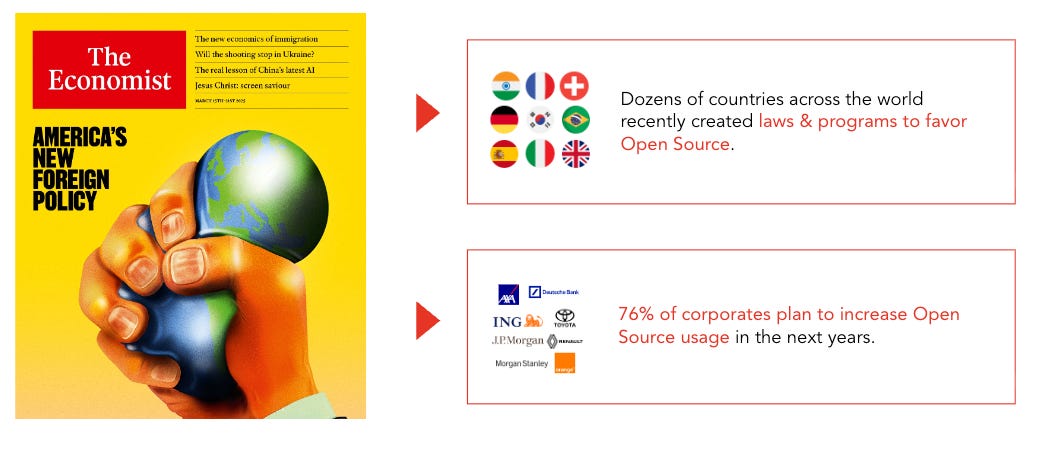
Rising global tensions and geopolitical shocks have triggered a wave of government and enterprise interest in open source for digital sovereignty.
European leaders in particular have awoken to the risks of over-reliance on foreign proprietary software. It became even more important since the election of Donald Trump and the trade war that followed. For a lot of CTOs and CIOs we’ve talked to in the last few months, it was a wake-up call. Sovereignty is no longer seen as a “nice-to-have”; it’s mission-critical.
And Open Source is regarded as essential for achieving digital sovereignty: the code is transparent and modifiable, there are no hidden backdoors, organizations aren’t beholden to a single vendor’s whims, etc.
Adopting Open Source lets governments and firms retain full control over their data and infrastructure on their own terms, free from foreign regulations or cloud providers. Open source software can be hosted locally to avoid extraterritorial reach (like U.S. subpoenas), and it’s auditable by the community for security. In fact, 89% of tech professionals say OSS is more secure than proprietary alternatives due to this transparency.
The European Union has explicitly recognized open source’s strategic importance: the upcoming EU AI Act exempts Open Source AI projects from certain heavy regulations to encourage their development, making OSS one of the pillars of Europe’s AI policy. European Commission President Ursula von der Leyen recently declared open technology an “indispensable pillar” of Europe’s digital independence vision.
Around the world, new laws and initiatives are favoring open source. A good example is Switzerland’s new “public money, public code” law (enacted in 2024), which mandates that all software developed for the federal government be released as open source.
The AI boom is amplifying these sovereignty concerns: nations don’t want to be dependent on a few Big Tech companies for critical AI capabilities. By embracing open models (like France’s support of Mistral AI or public funding for OSS AI research), governments hope to “level the playing field” and ensure no single foreign entity controls the AI future.
For both governments and enterprises, doubling down on OSS is a way to guarantee technological self-determination, transparency, and control over their destiny in a fraught global tech landscape.
4. Transparency and Escape from Vendor Lock-In
SaaS fatigue is real. For the first time in a decade, companies actually reduced the number of SaaS apps they use in 2023 (from 130 to 112 on average, according to BetterCloud).
Why? Rising costs, security concerns, and frustration with lock-in. Nobody wants to be held hostage to a closed vendor’s pricing changes or opaque APIs.
Open source solves this:
Auditability: You can see the code.
Portability: You can self-host or switch providers.
Interoperability: no data silos.
In regulated industries (finance, healthcare, government), open alternatives are often becoming the default requirement. Vendor transparency is now a boardroom topic, and Open Source is the only credible answer.
Besides, with the rise of AI, many SaaS providers are starting to close their APIs and restrict access to client data that was previously open. Reddit, for example, put a steep price on API usage, OpenAI recently tightened data export options for enterprise customers, and Salesforce has increasingly locked critical features like customer data pipelines and AI integrations behind proprietary APIs. Even Figma has been criticized for curtailing interoperability. These moves erode trust and push companies to reconsider their reliance on closed SaaS vendors.
5. With code becoming a commodity, Open Source becomes the best way to build a software business
AI has fundamentally changed the economics of building software. With tools like Codex, Cursor, Claude Code, and Lovable, anyone can now generate production-ready code or spin up a SaaS application in a matter of minutes. What once took a team of engineers months to develop can be scaffolded in hours. The result is that code itself has lost much of its scarcity value: code is becoming a commodity.
But that doesn’t mean software businesses are obsolete, far from it. It means the competitive advantage, or moat, is shifting. Instead of relying on proprietary codebases as barriers to entry, the new sources of defensibility are:
Community & brand: A vibrant community of users, contributors, and advocates creates momentum that code alone cannot replicate. Even if 80% of your product could be rebuilt overnight, the trust, brand recognition, and support ecosystem surrounding it are irreplaceable. Supabase, Hugging Face, or LangChain illustrate how the community can drive adoption at hyperspeed.
Data: In the AI era, data is a scarce resource. Proprietary datasets, usage telemetry, or fine-tuned benchmarks provide differentiation that can’t be cloned by a coding assistant. Companies like Hugging Face or Mistral leverage openness in code while monetizing through proprietary data, models, or optimized infrastructure.
As a result, if code is no longer the scarce asset, you lose little by open-sourcing it, and in fact, you gain more. By opening your code, you attract a larger community, reinforce your brand, and generate the flywheel effects that ultimately help you collect more data, which becomes the true moat. The bigger the community, the stronger the flywheel.
Of course, not all code will be commoditized equally. While LLMs can generate CRUD apps, SaaS backends, or frontend scaffolding with ease, deep technical and highly optimized infrastructure software remains out of reach for AI-generated code. Think of inference engines like vLLM, high-performance databases, low-level networking stacks, operating systems, cybersecurity tools, compilers, or real-time robotics frameworks. These require years of engineering, domain expertise, and fine-grained optimization that cannot simply be auto-generated by an LLM. In these categories, the code itself retains strategic value, but even here, openness accelerates adoption and trust.
Coding agent mostly recommends Open Source tools
Besides, as LLMs and coding agents are increasingly trained on Open Source code, the distribution advantage compounds. If you are building a developer tool or an infrastructure layer, going Open Source does not just grow your community; it also makes your project far more likely to be recommended and auto-completed by AI coding assistants like Codex, Cursor, Claude Code, or Lovable. These agents surface what they “know,” and what they know best is the open repositories they’ve been trained on.
That means that AI co-pilots mostly suggest Open Source tools by default. We already see this dynamic at work; tools like PostHog, Sentry, and Supabase consistently show up in coding assistants’ recommendations because their codebases are open and widely used. Over time, this creates a self-reinforcing loop: the more developers adopt your tool, the more it gets suggested by agents, and the more it spreads organically across the developer ecosystem.
In this new paradigm, open source becomes not only a trust and sovereignty advantage, but also a powerful distribution strategy baked into the future of software development itself.
Result: Open Source is at an Inflection Point
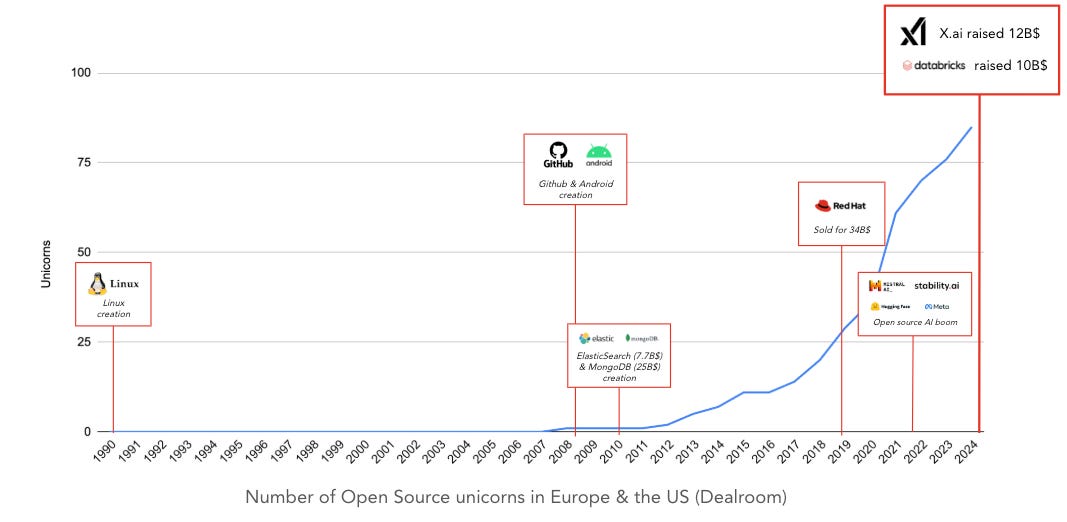
Let’s end with some facts that show just how far we’ve come:
OSS unicorns grew from fewer than 10 in 2013 to 90+ today.
96% of commercial applications now contain open-source components; on average, 77% of their codebase is made of Open Source code according to Synopsys.
In the last 5 years, Open Source companies financing has been multiplied by 3 across Europe and the US and reached 13.3b$ in 2024 alone, according to Dealroom data on Open Source startups
80% of CIOs plan to increase Open Source adoption in the next 12 months, according to Red Hat
Since 2018, Open Source startups have had 2.6x more exits per startup than other VC-backed companies, according to Dealroom data on Open Source startups
All the vectors are pointing in the same direction, and Open source is no longer the underdog. It is the default strategy for building the next generation of tech giants.
For investors, corporates, and policymakers, the conclusion is clear: the future is open. Now is the time to back the founders, projects, and funds building it. 🚀
This is a super comprehensve look at where open source is headed. The point about coding agents mostly recomending open source tools because thats what they were trained on is something I hadnt really considered, but it makes total sense and could become a huge distribution advantage. Im also curious about the sovereignty angle you mention, especially with the recent trade tensions. Do you think European companies will actually follow through on choosing open source alternatives, or is it more just talk when it comes down to the decision making process? Either way, its clear the momentum is shifting. Great articl btw, really enjoyed the data points you pulled together.